Speak Up For Salmon: February 2026
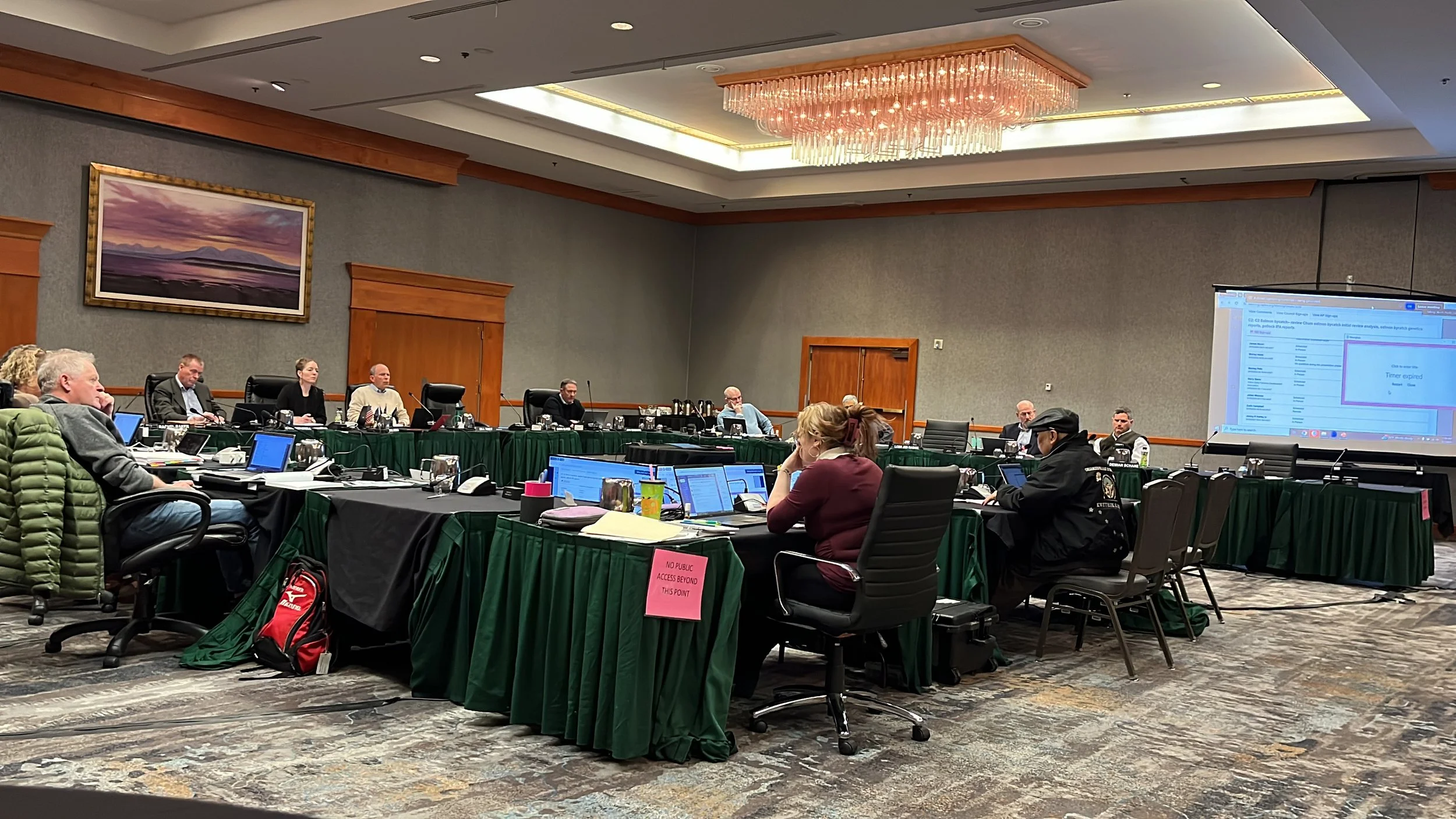
Photo by Terese Vicente/KRITFC.
More information will be added to this page as it becomes available. Last updated 12/23/2025.
In February 2026, both the North Pacific Fishery Management Council (NPFMC) and Alaska Board of Fisheries (BOF) will be discussing the management of salmon bycatch and intercept in marine fisheries. Here’s what you need to know.
Speak Up For Salmon Flyer. Click on the photo to enlarge or print.
Overview of salmon bycatch and intercept through 2024, from KRITFC’s 2024 End-of-Season Summary. Click the photo to enlarge.
NPFMC TO TAKE FINAL ACTION ON Bering Sea Chum Salmon Bycatch Management: February 2-11, 2026
This is a critical opportunity for Tribes and the public to advocate for reducing chum salmon bycatch in the Bering Sea.
Areas in the North Pacific region, from NPFMC. Click the map to enlarge.
The NPFMC manages federal fisheries 3–200 nautical miles from the Alaska coast. It has three main bodies: a Scientific and Statistical Committee (SSC), an Advisory Panel (AP), and the Council. The Council has 11 voting seats, 6 of whom are nominated by the State of Alaska, and none of which specifically represent Alaska Native Tribes.
Over the past several years, the NPFMC has been reevaluating management of chum salmon bycatch in the Eastern Bering Sea pollock trawl fishery’s B-Season. This fishery––the largest fishery in the U.S. by volume––is responsible for 99% of all chum salmon bycatch that occurs in the Bering Sea. Most chum salmon bycatch occurs in the B-Season, which runs each year from June 10 to November 1. On average, about 19% of the annual Bering Sea chum salmon bycatch comes from Western and Interior Alaska rivers, including the Kuskokwim, and there is currently no cap on the number of chum salmon that can be caught as bycatch.
Using available genetic information and bycatch data, we estimate that since 2011 (in the last 15 years), the pollock trawl fleet has caught at least 615,000 Western Alaska chum salmon as bycatch.
State of Bering Sea chum salmon bycatch, produced by Oceana in 2025.
In September 2025, the National Marine Fisheries Service (NMFS, or NOAA Fisheries) posted the Draft Environmental Impact Statement (EIS) for Chum Salmon Bycatch Management. KRITFC, as well as the Tanana Chiefs Conference (TCC) and Alaska Department of Fish & Game, have been cooperating agencies in the development of this EIS analysis. The NPFMC is planning to take Final Action on the alternatives presented in this Draft EIS from February 2-11, 2026, in Anchorage.
The 5 alternatives up for consideration are:
Status quo/No action.
An Bering Sea-wide cap between 100,000 to 550,000 chum salmon, in place each year.
A Bering Sea-wide cap between 100,000 to 550,000 chum salmon, in effect in years following low chum salmon returns.
Additional mandatory requirements for the pollock industry’s contractual agreements.
A cap of 50,000 to 350,000 chum salmon in a time and area of highest Western Alaska chum salmon bycatch.
Staff from KRITFC and TCC recorded a presentation giving an overview of the NPFMC process, chum salmon bycatch in the Bering Sea, our work as cooperating agencies, and how these alternatives differ. Watch our presentation on YouTube here or below.
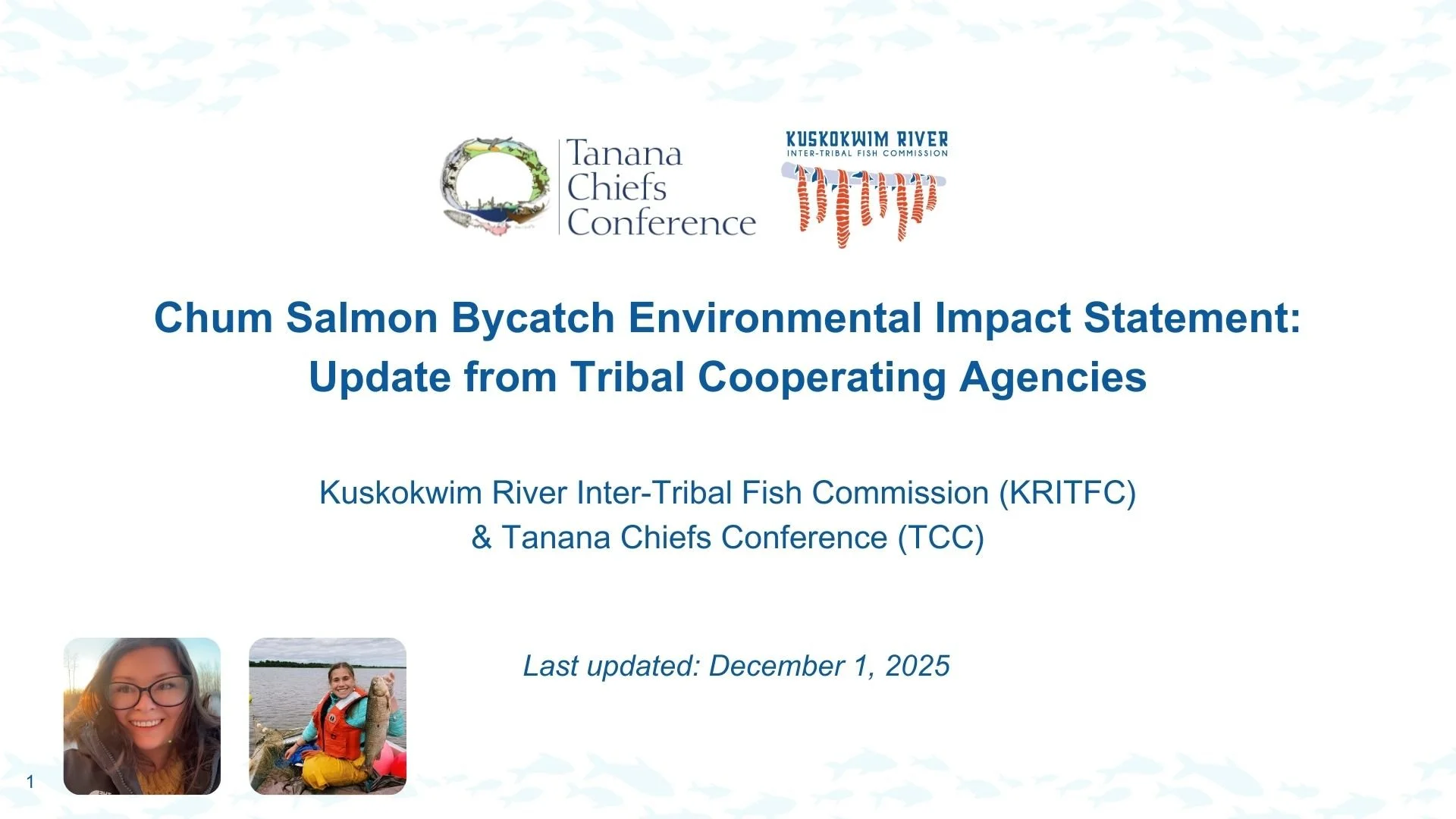
You can view, download, or print a copy of our presentation slides here.
You can engage by:
Submitting a written comment to on the Draft EIS to NOAA Fisheries by January 5, 2026. Info here. Click here for guidelines to providing a helpful comment.
Submitting a written comment on the Draft EIS, and/or recommendations for the NPFMC’s Final Action, to the NPFMC by January 30, 2026.
Requesting Tribal Consultation with NOAA Fisheries between now and February (Tribal governments, ANCs, and authorized consortia only).
Attending and testifying at the NPFMC meeting in Anchorage or virtually.
Documents and more information:
Full Draft EIS available here.
Executive Summary of the Draft EIS available here.
Read KRITFC’s comment letter to the Federal Register, posted January 5, 2026.
Read KRITFC’s comment letter to the NPFMC, posted January 29, 2026.
Read information from Tanana Chiefs Conference here.
Info about the NPFMC process:
Association of Village Council Presidents (AVCP) guidebook here.
Alaska Marine Conservation Council (AMCC) guidebook here.
NPFMC engagement flyers here.
Video on how to submit a written comment, created by Tanana Chiefs Conference (TCC), here.
Information on how to sign-up to testify at the bottom of this webpage (the process is the same as last February!)
BOF TO consider proposed regulation changes to area m fisheries: Feburary 18-24, 2026
This is a critical opportunity for Tribes and the public to advocate for safe passage of Western and Interior Alaska salmon through the Area M fishery.
Map of the Alaska Peninsula Management Area, including the Area M areas (Unimak District and Shumagin Islands), from Fox et al. 2021. Click the map to enlarge.
The BOF develops regulations for all state fisheries, both inland and from the coast to 3 nautical miles offshore. These regulations are carried out by the Alaska Department of Fish & Game. There are 7 members on the BOF, nominated by the Governor and approved by the State Legislature. Currently, three are Alaska Native BOF members (though they are not representing Tribes): Curt Chamberlain from Aniak, Märit Carlson-van Dort from Chignik, and Olivia Henaayee Irwin from Nenana.
One of the fisheries the BOF develops regulations for is the South Alaska Peninsula, or Area M, purse seine, drift gillnet, and set gillnet fisheries. Collectively, the Area M fishery catches and sells large numbers of migrating chum and Chinook salmon from Western and Interior Alaska rivers (including the Kuskokwim), particularly during the month of June. Different genetic studies have shown between 18–57%, and most recently 28%, of chum salmon caught in June are from Western and Interior Alaska. Approximately 20.5% of Chinook salmon landed in the Area M fishery throughout the summer are from Western and Interior Alaska.
Using the best available genetic information, we estimate that Area M commercial fishermen have harvested and sold at least 1.3 million Western Alaska chum salmon and 46,200 Western Alaska Chinook salmon since 2011.
From February 18-24, 2026, the BOF will be discussing proposed regulatory changes to the Area M fishery, which would be in effect from 2026-2028 per the BOF’s three-year cycle. Proposals submitted in April 2025 were posted in September 2025. There are several proposals that aim to reduce opener periods and/or extend closures between openers in the Area M fishery to create a migratory corridor for Western and Interior Alaska salmon.
You can engage by:
Submitting a written comment to the BOF by February 3, 2026.
Requesting a meeting with BOF members or the Commissioner of Fish & Game.
Attending and testifying at the BOF meeting in Anchorage. Virtual testimony is not supported at this time.
Documents and more information:
All Alaska Peninsula / Aleutian Island / Chignik Finfish proposals here.
Proposals 126-137, specific to the Area M June fishery management plan, here.
February 18-24, 2026 BOF Meeting Page
Info about the BOF process:
Association of Village Council Presidents (AVCP) guidebook here.
BOF process one-pager here.
Toolkit from Native People’s Action here.
KRITFC is committed to keeping Kuskokwim Tribes and residents informed about these actions. For questions, more information, help with comment letters or testimony, or to request printed copies of any of these documents, please contact Terese Vicente, Policy & Programs Director, at terese@kritfc.org or 907-545-5022.